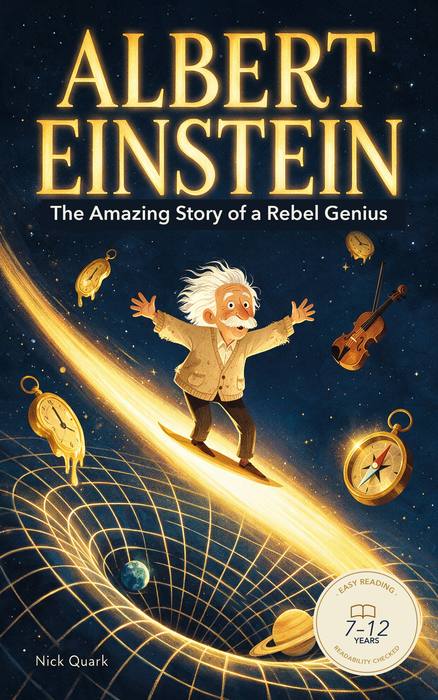
Albert Einstein
The Amazing Story of a Rebel Genius
He took three years to start talking. A teacher told him he would never amount to anything. And at twenty-six he rewrote the universe from a paperwork office.
- Paperback
- 24 illustrations
Biographies for curious kids · Ages 7–12
Illustrated biographies of the scientists who changed the world, written for the age when you still ask about everything.
Seven true stories, each with its illustrations, its checked facts, and a full list of sources at the back.
The Amazing Story of a Rebel Genius
He took three years to start talking. A teacher told him he would never amount to anything. And at twenty-six he rewrote the universe from a paperwork office.
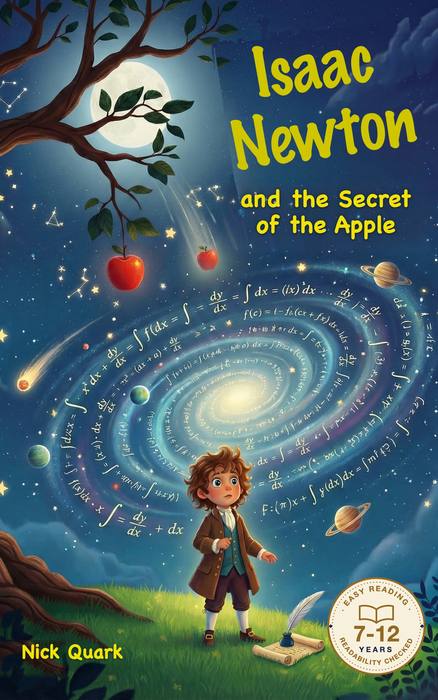
The Secret of the Apple
He was so small at birth they said he could fit in a quart pot. He was the worst farmer in England. And at twenty-three, shut away from the plague, he worked out how the universe runs.
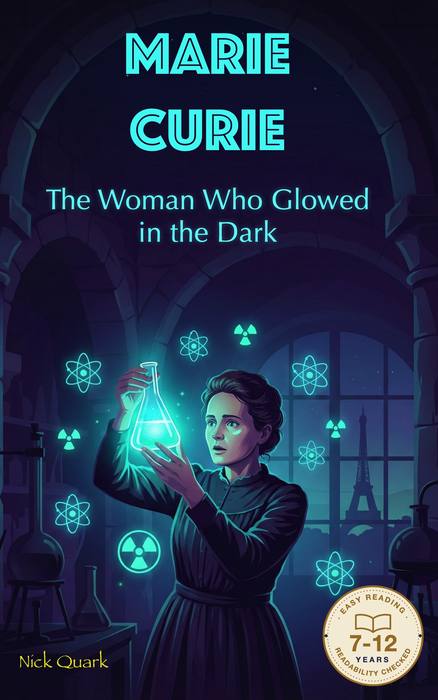
The Woman Who Glowed in the Dark
She slept under a pile of coats in a freezing attic. She stirred tons of rock in a leaky shed. And one night, the test tubes on her shelves began to glow in the dark.
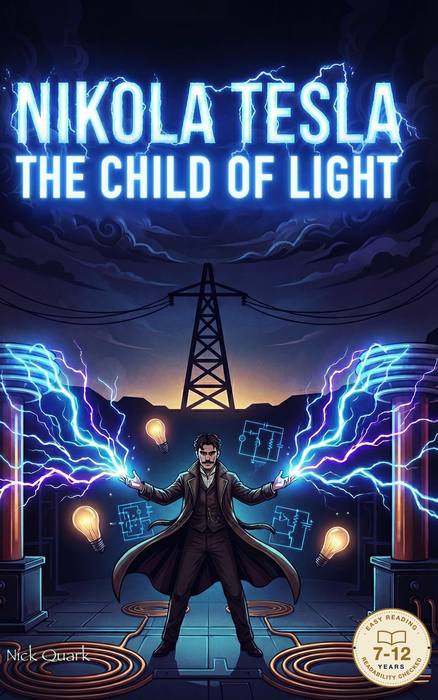
The Child of Light
He arrived in New York with four cents in his pocket. He dug ditches to survive. And then he lit up the world.
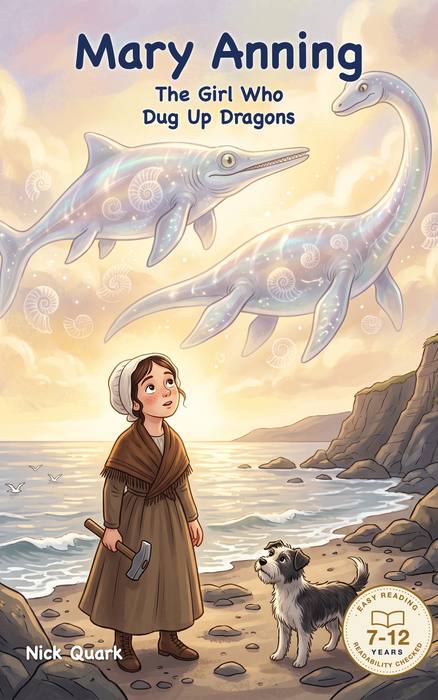
The Girl Who Dug Up Dragons
She survived a lightning strike as a baby. At twelve she helped pull a sea monster out of a cliff. And the learned men of London wouldn’t let her into their meetings.
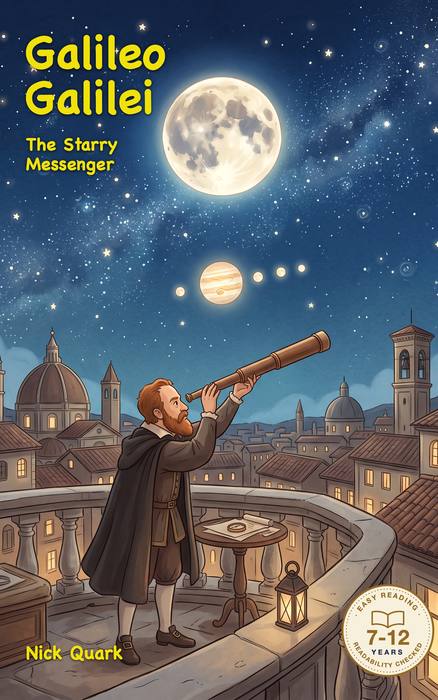
The Starry Messenger
He pointed a spyglass at the sky and saw mountains on the Moon and four moons around Jupiter. For telling what he had seen, he ended up on his knees before a court.
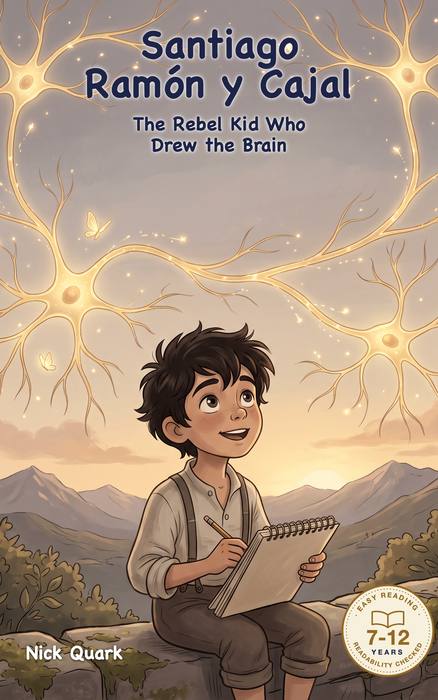
The Rebel Kid Who Drew the Brain
At eleven he was locked in the village jail for blasting a hole in a gate with a homemade cannon. His father sent him to work for a shoemaker to cure him of drawing. He ended up drawing the human brain and winning the Nobel Prize.
An imprint of science biographies for readers aged 7 to 12, with two rules we never bend: everything in the book really happened, and a child can read it on their own.
Dates, numbers, and quotations come from documented sources, and every book ends with its full list of sources so readers can check for themselves. Letters and diaries are quoted in their original words wherever they were written in English.
The apple on Newton’s head, Galileo’s “And yet it moves,” the lightning that made Mary Anning clever: every book has a Myths and Truths section that sorts the real stories from the famous ones.
Short chapters, real adventures, experiments to try at home, and a glossary at the back. A well-pitched book entertains, teaches and, above all, makes a child want to turn the page.
A free reading guide for every book, as a printable PDF, to use after reading.
No tests. Each guide has chapter-by-chapter comprehension questions, a timeline of the scientist’s life with blanks to fill in, science vocabulary explained at the right level, a safe experiment with things from home, and a final page of answers for the grown-up. Four A4 pages, designed to print in black and white.
Free. Print and photocopy them as often as you like, at home or in class.
If you teach and something is missing, or you’d like to tell us how they worked in your classroom, write to us: we read every message.
Questions, typos, school and bookstore enquiries, or just telling us what your child or your class thought of the book. We read every message.